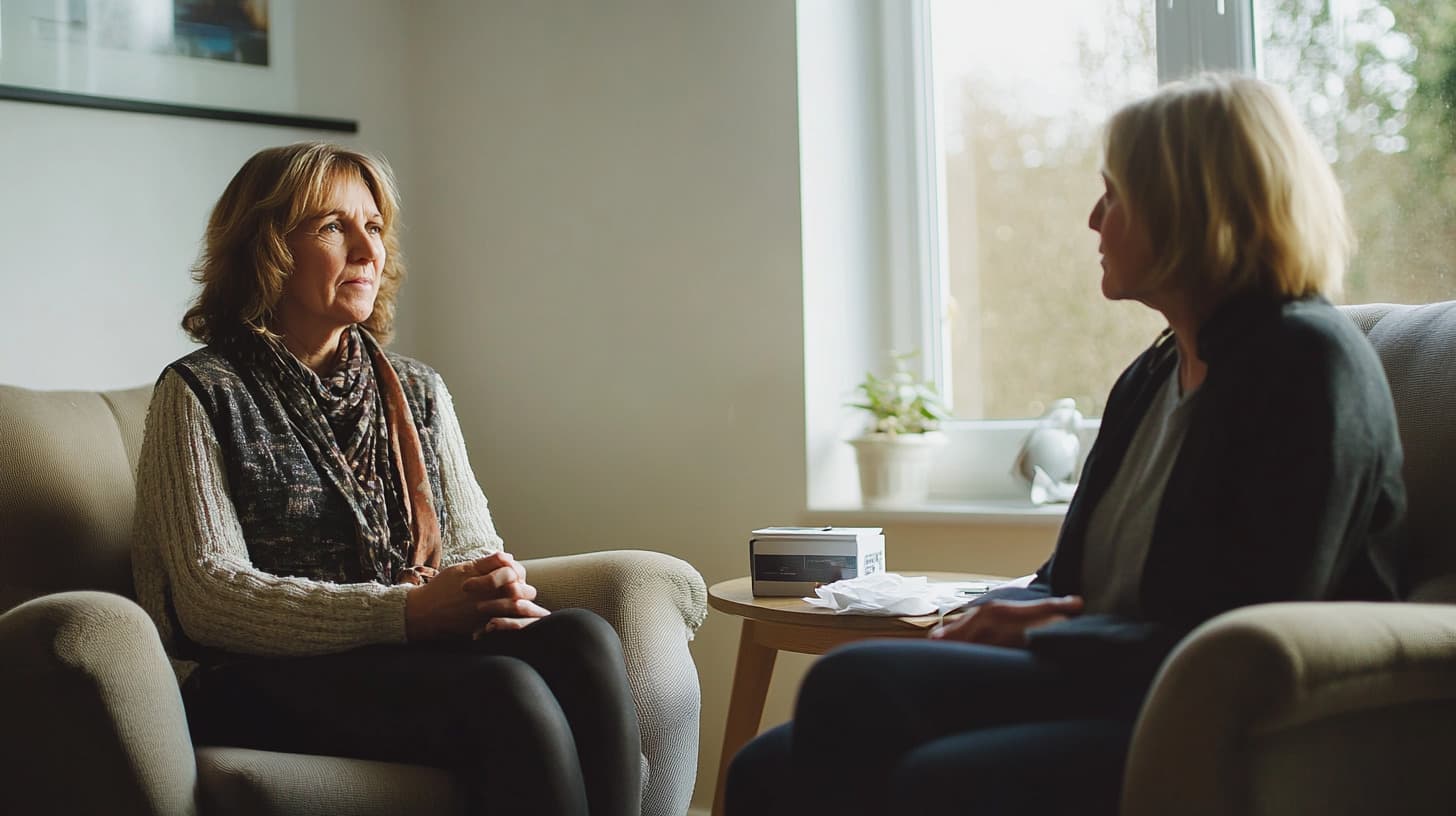
Grief does not begin at death. It begins at diagnosis. Professional support for the grief you are already carrying is available now, and getting it sooner rather than later makes a real difference.
Anticipatory grief
Anticipatory grief is the grief you experience before a loss has happened. It is grief for the future: for the life that will no longer be shared, for the person you are watching decline, for the things that will be different, and for the death that is coming. It is real grief, and it deserves real support.
Anticipatory grief is often complicated by the fact that the person you are grieving is still alive. You may feel guilty for grieving. You may feel pulled between wanting to be fully present to the time that remains and already mourning. These are not contradictions. They are the normal human experience of loving someone who is dying.
If you are carrying this and it is affecting your sleep, your ability to function, or your capacity to be present, that is a reason to seek support. Not as a sign of weakness, but as an act of self-care that makes you more able to be there for the person you love.
Finding a grief counsellor
For grief specifically related to dying and death, seek a counsellor or psychologist who has specific experience in grief, bereavement, or palliative care. A generalist counsellor is not always the right fit for the specific texture of this kind of loss.
Your palliative care team will often have a social worker or psychologist with experience in this area. Ask them. The Australian Psychological Society (psychology.org.au) has a Find a Psychologist directory where you can search by area of practice. Griefline (griefline.org.au), now part of SANE Australia, offers free phone support from trained volunteers, online forums, and referrals to grief counsellors.
For Medicare-rebated sessions with a psychologist, ask your usual GP for a Mental Health Treatment Plan. It gives access to up to 10 individual sessions each calendar year. Carers can also get free counselling through Carer Gateway (carergateway.gov.au, 1800 422 737), by phone or in person, without a GP referral.
Support for children and young people
Children and teenagers who are close to the person who is dying experience grief too, and they often lack the language or the permission to express it. Do not assume that children are too young to understand, or that they are coping because they seem fine.
Children benefit from honest, age-appropriate information about what is happening. Euphemisms ("going to sleep", "passing away") confuse young children and can create lasting associations between sleep and death. Direct, kind language ("he is very sick and the doctors cannot make him better; he is going to die") is kinder than it sounds.
Grief Australia (grief.org.au), formerly the Australian Centre for Grief and Bereavement, has resources specifically for supporting children through grief. Feel the Magic (feelthemagic.org.au) runs free grief camps for children and young people aged 7 to 17 after the death of a parent, guardian or sibling. Ask the palliative care social worker or your GP about local services for children and teenagers.
A family counsellor who specialises in children and grief can be invaluable. If there are young people in the family who are struggling, seek this out sooner rather than later.
Online and phone support
If getting to a counsellor in person is difficult, several Australian services offer phone and online grief support.
Griefline (griefline.org.au, 1300 845 745) provides grief support by phone, Monday to Friday, 10am to 8pm eastern Australian time. This is not a crisis line; it is specifically for people experiencing grief and loss, including anticipatory grief.
Beyond Blue (beyondblue.org.au, 1300 22 4636) provides support for anxiety and depression, which commonly accompany grief. The Beyond Blue online chat service is available 24 hours a day.
Lifeline (lifeline.org.au, 13 11 14) provides crisis support around the clock for people experiencing acute distress.
After the death: bereavement support
Planning for bereavement support before the death is wise. If you have a counsellor or psychologist you have been seeing through the final weeks, that relationship will be invaluable in bereavement. Ask them now whether they offer bereavement support and whether you can continue working together after the death.
Your palliative care team typically offers bereavement follow-up for family members for a period after the death. Ask what is available. Many services offer a phone call, a bereavement visit, and a referral to ongoing bereavement counselling if needed.
Grief is not something to move through quickly. There is no timeline, no correct way to grieve, and no point at which you should be "over it". Good bereavement support meets you where you are, for as long as you need it.
Platform tools
- Your checklistEvery task across all five stages of the journey, gathered in one place so nothing is forgotten.
- Find a specialistLocation-aware search for medical specialists, palliative care teams, solicitors, financial advisers, and grief support services across Australia.
Was this guide helpful?
Pierre started 18December after his partner Mark was given a terminal diagnosis, when they mapped out everything that needed to happen at the kitchen table. He reviews the guides to keep them honest, plain, and genuinely useful. About 18December
Last reviewed 1 October 2026
Read the latest version of this guide at www.18december.com.au/guides/grief-counselling
© 2026 18December Pty Ltd. All rights reserved. This guide is original content and may not be reproduced, distributed, or republished without written permission.
← Back to Making the most of the time